
Residential & commercial service
Driveway & Concrete Cleaning
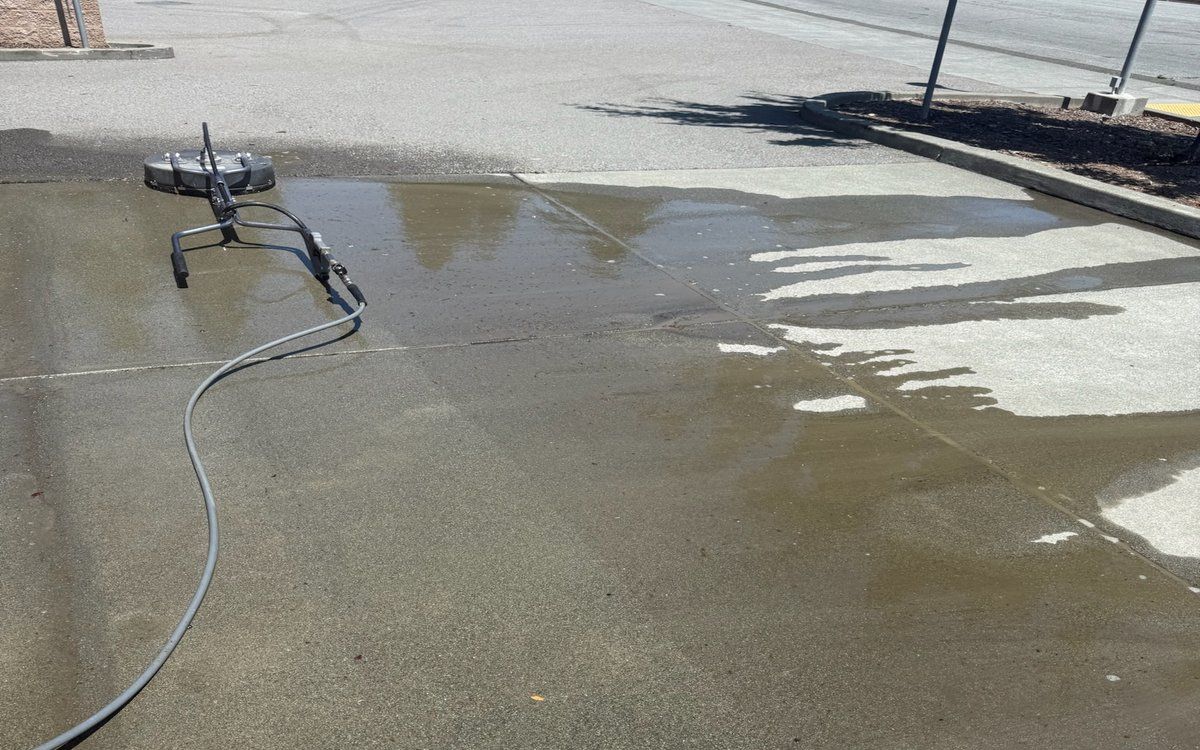
Driveway and concrete cleaning strips embedded dirt, oil, tire film, and organic staining out of concrete flatwork. Plain concrete is one of the few surfaces that genuinely calls for high pressure, so we run commercial surface cleaners at 3,000 PSI and up for an even, stripe-free finish, then spot-treat stains with the right chemistry for each one.
What Concrete Cleaning Includes
We clean driveways, sidewalks, walkways, curbs, garage aprons, and concrete patios. The job starts with a pre-treatment on organic staining, then a full pass with a walk-behind surface cleaner, then targeted work on problem spots: degreaser on oil, an oxalic-based rust remover on irrigation stains, and a post-treatment rinse that keeps mildew from coming right back in the shaded sections. Edges and corners the surface cleaner cannot reach get finished by wand.
Why a Surface Cleaner Beats a Wand
Anyone can rent a pressure washer and streak up a driveway. The zebra striping you see on badly cleaned concrete comes from uneven wand passes at inconsistent distance and angle. A commercial surface cleaner solves that: two spinning nozzles under a hooded deck deliver uniform pressure across the whole path, so the finish comes out even from the garage door to the street. Bare concrete flatwork handles 3,000 to 4,000 PSI without issue. What it does not handle is a turbo nozzle held too close, which can permanently etch lines into the cream layer, and that is why technique matters as much as equipment.
The Stains Central Valley Concrete Collects
The stain profile here is predictable. Hard irrigation water leaves orange rust trails wherever sprinklers overspray the driveway, and those will not budge under pressure alone; they need acid-based rust chemistry. Tule fog winters feed black and green organic growth in shaded, damp sections, which is a slip hazard as much as an eyesore. Add tire film at the parking spots, leaf tannin stains every fall, and the fine ag dust that works into the pores of the concrete all summer, and a driveway can go from bright to gray in a couple of seasons.
What Affects the Cost
Square footage sets the baseline. From there, the biggest variables are stain load and stain type, because oil and rust take dedicated chemistry and extra passes while plain gray grime does not. Access and water supply matter on larger commercial lots. Every job gets a written flat quote up front, so there is no hourly meter running and no surprise at the end.
How Often to Clean Concrete
Once a year is the right rhythm for most driveways in this region, ideally in spring after fog season has fed a winter of growth. Shaded driveways and anything near heavy irrigation may want attention more often. If you are planning to seal your concrete, cleaning first is mandatory, and a freshly cleaned and sealed driveway stays bright far longer than bare concrete.
Questions We Actually Get
Can you remove oil stains from my driveway completely?
Usually most of the stain, and often all of it, but it depends on age and depth. Fresh oil that sits on the surface responds well to degreaser and hot-water washing. Oil that has soaked deep into unsealed concrete for years may leave a faint shadow even after treatment. We treat it, tell you honestly what came out, and never promise perfection on decade-old stains.
What causes the orange stains on my concrete and can they be removed?
That orange staining is rust from iron in hard irrigation water, and yes, it is removable. Pressure alone will not touch it because the iron has bonded into the concrete pores. We use an oxalic-acid-based rust remover that dissolves the deposit so it rinses away. Fix the sprinkler overspray and it will stay gone.
Will pressure washing damage my concrete?
Not when it is done correctly. Sound concrete flatwork is built to handle high pressure, and a surface cleaner spreads that pressure evenly. Damage happens when a turbo nozzle is held too close or when old, spalling concrete is hit at full pressure, and we adjust for surface condition before we start. If your concrete is already flaking, we dial back and tell you.
Should I seal my driveway after cleaning?
It is worth considering, especially for newer concrete. A penetrating sealer slows oil absorption, blocks irrigation rust from bonding, and makes every future cleaning easier. Sealing only makes sense on clean concrete, so the order is always clean first, seal second, once the surface has fully dried.
How long before I can drive on the driveway after cleaning?
Immediately, in most cases. Pressure washing uses water, not coatings, so once we finish rinsing, the surface just needs to shed standing water. If we apply a post-treatment or a rust remover, we will tell you if a short wait is needed, and if the driveway gets sealed, plan on staying off it until the sealer cures per its directions.
Ready to make it look new again?
Fast scheduling. Photo-documented results. A written quote before any work starts.