
Commercial service
Shopping Center Pressure Washing
We maintain the full common area of shopping centers: storefront sidewalks, gum-heavy entries, dumpster corrals, cart areas, food-tenant patios, and drive lanes. Overnight route service keeps every tenant frontage clean on a recurring schedule, with wastewater recovery on grease work and a photo report after each visit.
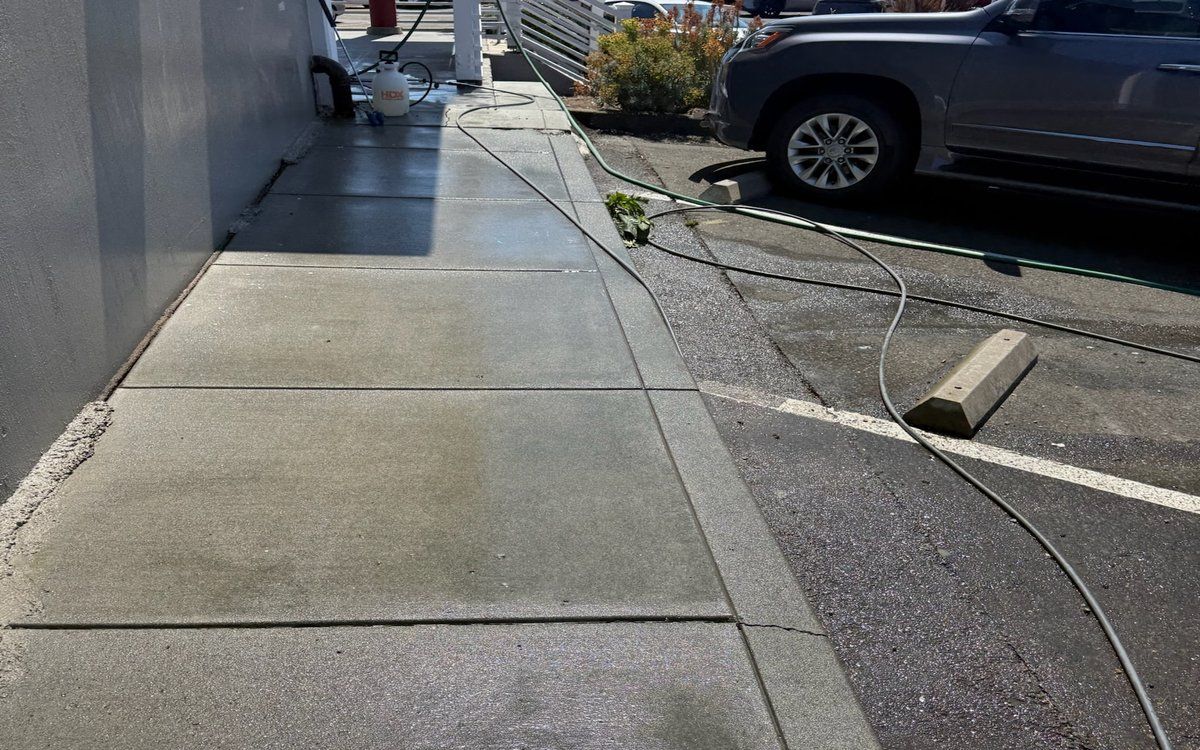
One property, a dozen soil problems
A shopping center concentrates every exterior cleaning problem in one place. Gum density in front of food and beverage tenants can reach dozens of pieces per pad. Restaurant end-caps push grease onto shared sidewalk. Dumpster corrals serving multiple tenants build up leachate and odor faster than any single-tenant pad. Bird droppings collect under canopies and signage, cart corrals stain their corners, and shaded walkway runs grow algae through the wet season. We work the full common area systematically: surface cleaners on the long sidewalk runs, hot water on gum and grease zones, soft washing on canopies and fascia, and dedicated degreasing with wastewater recovery at the corrals.
Common-area condition is a leasing asset
Center owners sell foot traffic, and foot traffic responds to condition. A clean, bright sidewalk run keeps shoppers moving past every storefront; a gum-blackened, stained one drags down every tenant's frontage, including the anchors whose leases often spell out common-area maintenance standards the landlord must meet. CAM-funded washing is one of the few line items every tenant benefits from visibly. And with pedestrian volume comes claim exposure: grease migration outside a restaurant tenant or algae on a shaded walk is a slip hazard on the landlord's common area, which makes the dated photo trail from recurring service worth as much as the cleaning.
Route service across the whole center
We run centers on an overnight route: crews work after tenant close, sequence through the property zone by zone, and finish before early deliveries arrive. Recurring plans typically rotate so high-need zones, food-tenant frontage and dumpster corrals, get monthly attention while the balance of the sidewalk network cycles quarterly. One contract covers the whole common area, one report after each visit shows every zone serviced, and your tenants simply arrive to clean frontage.
Grease zones get compliant handling
The corrals and restaurant frontages are grease work, and grease work means the wash water cannot reach the storm system. We capture and recover wash water in those zones and dispose of it off site, keeping the center compliant with municipal discharge rules. The rest of the flatwork is cleaned with drain inlets protected and detergents controlled. Discharge violations attach to the property, so the vendor's method is the owner's risk; ours is built to remove it.
What shapes your quote
Center contracts are scoped on linear frontage and total common-area square footage, gum density, the number of food tenants and dumpster corrals, canopy and fascia work, night-access logistics, and the rotation frequency. A center on a standing route carries a lighter per-visit load than one being rescued from years of buildup, and first-visit restoration is scoped separately from the recurring rate. We walk the property, zone it, and deliver a written plan the CAM budget can rely on.
Questions We Actually Get
Can you clean the whole center without disturbing tenants?
Yes. All work runs overnight after tenant close, sequenced to finish before morning deliveries. Tenants open to clean frontage and never see the crew.
Do different zones of the center need different frequencies?
Almost always. Food-tenant frontage and dumpster corrals typically need monthly service, while general sidewalk runs hold up on a quarterly cycle. We build the rotation so each zone gets the frequency its soil load demands, under one contract.
Can this be billed through CAM?
The structure fits CAM handling: a fixed recurring contract with a defined scope, consistent monthly documentation, and photo reports that show tenants what the charge bought. Your accounting team gets clean paperwork every cycle.
How do you deal with the gum in front of food tenants?
Hot water, applied with technique that releases the gum rather than blasting it, which protects the concrete from chipping. Heavy accumulations come out in the first restoration visit; the recurring schedule then keeps pads clear before buildup returns.
What happens to the greasy water from the dumpster corrals?
We recover it. Corral wash water carries grease and cannot go to the storm drain, so it is captured, vacuumed, and disposed of off site. The center stays compliant, and the report documents the handling.
Ready to make it look new again?
Fast scheduling. Photo-documented results. A written quote before any work starts.